





General Overview and Facts and Figures
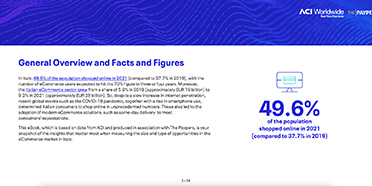
In Italy, 49.6% of the population shopped online in 2021 (compared to 37.7% in 2019), with the number of eCommerce users expected to hit the 70% figure in three or four years. Moreover, the Italian eCommerce sector grew from a share of 5.9% in 2019 (approximately EUR 19 billion) to 9.2% in 2021 (approximately EUR 28 billion). So, despite a slow increase in internet penetration, recent global events such as the COVID-19 pandemic, together with a rise in smartphone use, determined Italian consumers to shop online in unprecedented numbers. These also led to the adoption of modern eCommerce solutions, such as same-day delivery, to meet consumers’ expectations.
This eBook, which is based on data from ACI and produced in association with The Paypers, is your snapshot of the insights that matter most when measuring the size and type of opportunities in the eCommerce market in Italy.

49.6%
of the population
shopped online in 2021
(compared to 37.7% in 2019)
2 / 19


Total Population
59.4 million
Internet Penetration (internet users % of total population)
84.7
Internet Banking Penetration (% aged 16+)
41.0
Age Breakdown
| 0-14 | 15-64 | 65 and above | |
| 2015 | 13.8% | 64.5% | 21.7% |
| 2025 | 12.0% | 63.3% | 24.7% |
Banked Population
(% aged 15+)
96.5
Mobile Penetration
(per 100 people))
135.9
Smartphone Penetration by Age Group
| 16-24 | 24-34 | 35-44 | 45-54 | 55-64 | 65-74 | 75+ |
| 92% | 89% | 87% | 82% | 72% | 44% | 13% |
Italy’s most popular international markets for cross - border eCommerce are:
| to China | to Germany | to UK |
| 38% | 17% | 16% |
| % of cross-border purchases | ||
eCommerce Value

2021: EUR 77 billion

-1%
Nearly same (nearly -1%
decrease) volume of
eCommerce transactions,
2021 vs 2020

+25%
Increase in average
ticket value (ATV)
52%
eCommerce
Penetration
3 / 19
The Local eCommerce Space and Shopping Behavior
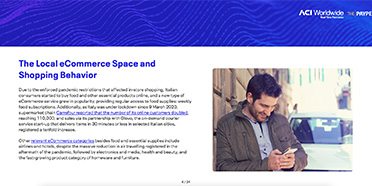
Due to the enforced pandemic restrictions that affected in-store shopping, Italian consumers started to buy food and other essential products online, and a new type of eCommerce service grew in popularity, providing regular access to food supplies: weekly food subscriptions. Additionally, as Italy was under lockdown since 9 March 2020, supermarket chain Carrefour reported that the number of its online customers doubled, reaching 110,000, and sales via its partnership with Glovo, the on-demand courier service start-up that delivers items in 30 minutes or less in selected Italian cities, registered a tenfold increase.
Other relevant eCommerce categories besides food and essential supplies include airlines and hotels, despite the massive reduction in air travelling registered in the aftermath of the pandemic, followed by electronics and media, health and beauty, and the fast-growing product category of homeware and furniture.
4 / 19
Italia Cashless and Other Particularities of the Market
The most popular online retailers among Italian consumers include Amazon, eBay, Zalando, Mediaworld, UniEuro, Subito, Decathlon, Leroy Merlin, IBS, and ManoMano, and it is also worth mentioning that luxury goods – especially those in the clothing and shoes segment – are very relevant for this market. In 2021, premium products were more popular via online retail channels rather than in-store, and goods priced over EUR 150 accounted for 34% in online sales and 23% in offline sales. So, it is no wonder that Italian retailers make their services and products available through more channels, from eCommerce platforms and marketplaces to social media.
When it comes to the particularities of the Italian eCommerce market, it is also worth mentioning that in 2020, the Government introduced a cashback programme. It is part of ‘Italia Cashless’, a plan developed by the Government to encourage the use of cards and payment apps, in order to modernise the country and encourage the development of a more digital, fast, simple, and transparent system. However, the Government issued a Law Decree on 30 June 2021 stating that the Cashback programme is to be suspended from 1 July to 31 December 2021 – with postponement for a definitive decision to 2022.

In 2021, premium products
were more popular via online retail channels
rather than in-store
5 / 19
Gaining a Competitive Edge
through Cross-Border eCommerce
As the eCommerce sector in Italy is expected to see exponential growth in the following years, this is a great opportunity for online retailers that want to sell across borders. Seeking more choice and variety, Italian online shoppers already acquire products across borders in high numbers, with half having already purchased from international merchants by 2021. Italy’s most popular international markets for cross-border eCommerce are China (with 38%), followed by Germany (17%), and the UK (16%).
Some pointers for online retailers that want to start selling in Italy would be to provide free shipping and returns, to broaden and optimise the payment solutions offered, to provide Italian-language personalisation when opening their online stores in Italy, and to use local carriers and warehouses, since many Italians trust Poste Italiane, the local postal service provider. Zalando, for instance, increased its turnover by 21.6% in 2020, also thanks to its partnership with Poste Italiane, which allows online shoppers to collect and return packages at approximately 12,000 authorised Italian post offices and through the Punto Poste network (7,300 tobacco shops, 200 affiliated shops, and 350 lockers).

Zalando partners with
Poste Italiane & increases
turnover by 21.6%
6 / 19
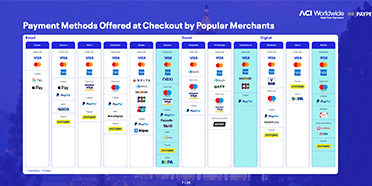
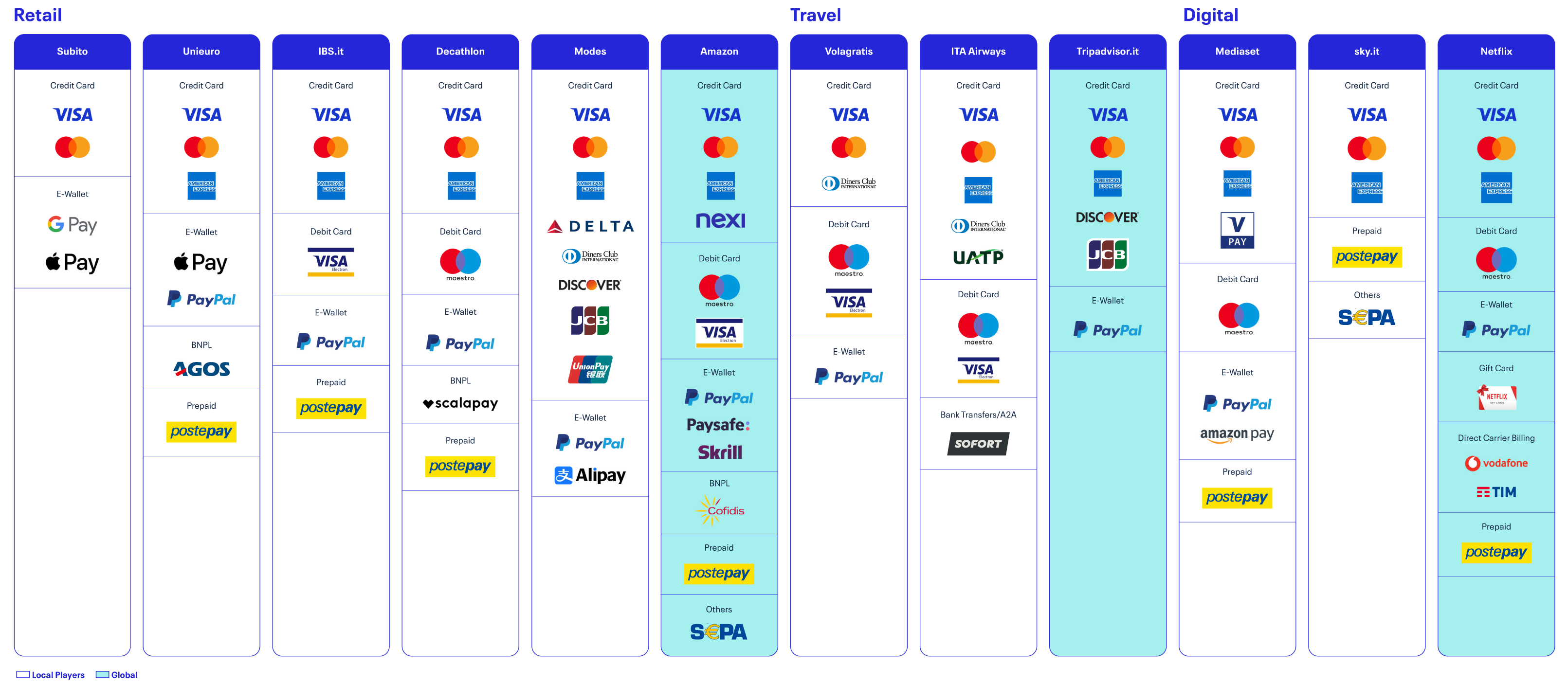
Payment Methods Offered at Checkout by Popular Merchants
7 / 19
The Local Payments Space
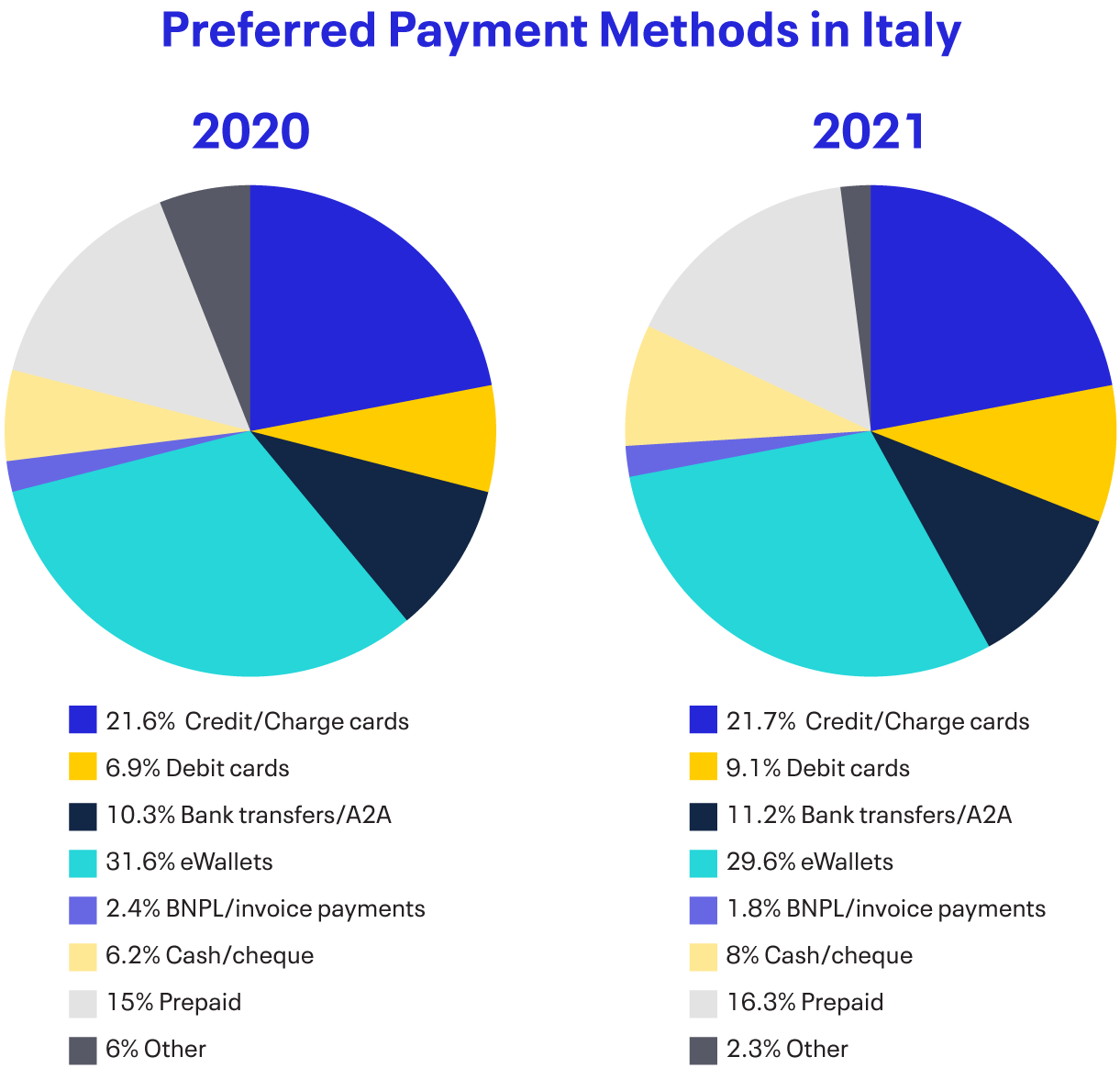
Source: Global Data information
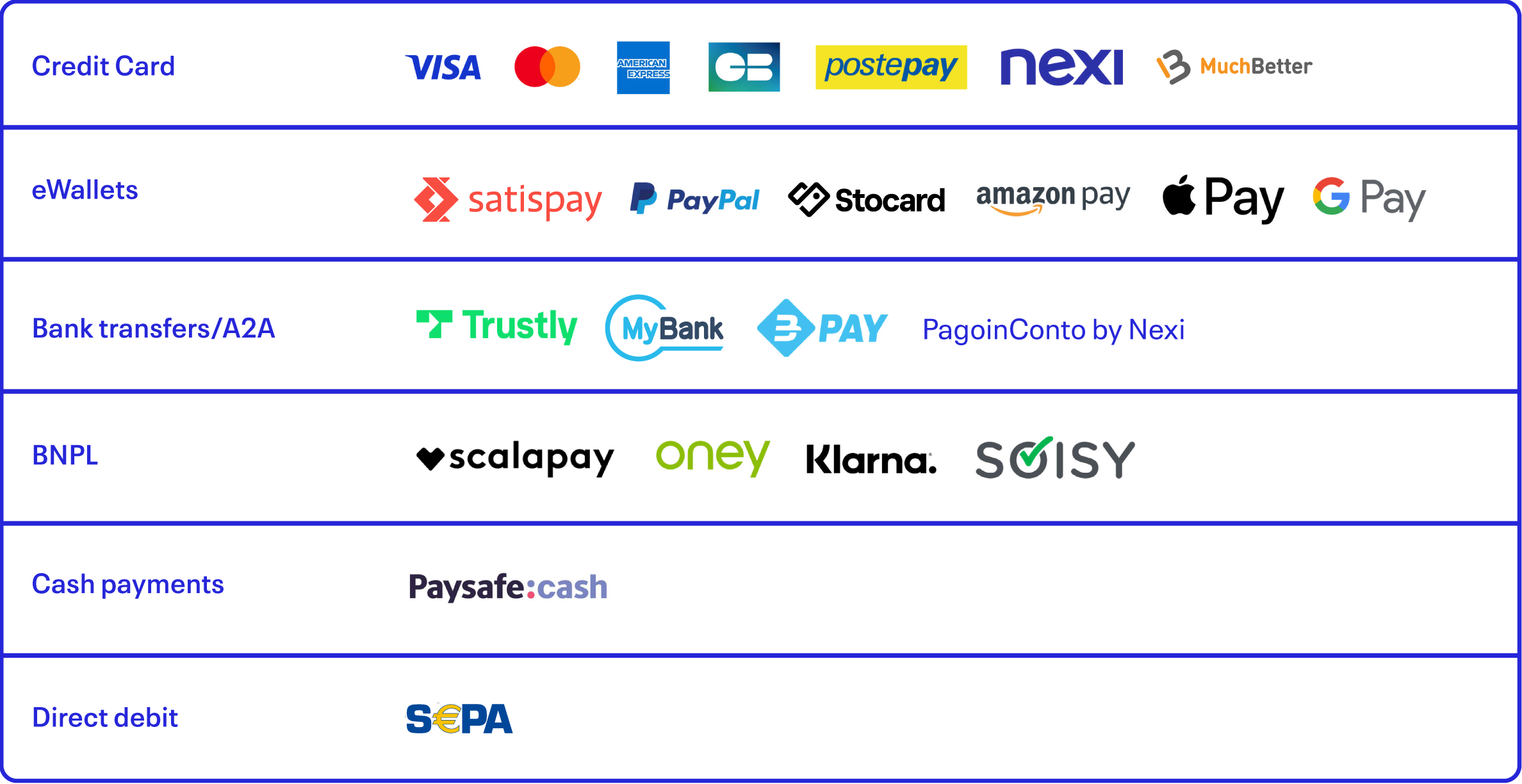
Following the introduction of the ‘Italia Cashless’ plan and further streamlined by the lockdowns, online payments grew in popularity – being preferred by 6 out of 10 Italians in 2020 – with credit cards, prepaid cards, and vouchers being used most often. Other noteworthy payment methods that experienced growth in the last couple of years are e-wallets (such as Satispay, Stocard, PayPal, Amazon Pay, Apple Pay, Google Pay), bank transfers (BancomatPay, MyBank, Nexi, Trustly), and BNPL (Soisy, Scalapay, Clearpay, Klarna).
Additionally, as more Italian consumers will switch to online shopping, businesses are expected to upgrade their payments infrastructure, as Uber Eats did in 2020, allowing merchants to receive payments daily rather than weekly, as well as increasing the number of devices merchants can use for processing orders. Thus, we can expect to see further enhancements to the payments infrastructure in Italy.
8 / 19
Relevant Payment Methods in Italy
9 / 19
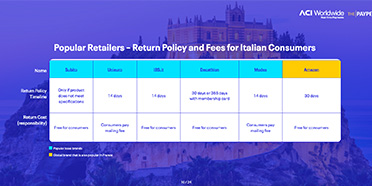
Popular Retailers – Return Policy and Fees for Italian Consumers
Name
Return Policy
Timeline
Return Cost (responsibility)
Popular local brands
Global brand that is also popular in France
10 / 19
Logistics, Refunds and Return Policies
As we’ve seen, there were several factors driving Italians to shop online more often, leading to the adoption of more modern eCommerce solutions, such as same-day delivery. However, this is not the standard delivery time expected by Italian consumers. According to a Statista survey carried out in 2021, most Italian online shoppers (68%) expect to receive their purchased products within 3 to 5 days, followed by those that expect the delivery to happen in 1 to 2 days (19%), or even 6 days or more (11%).
When it comes to refund and return policies for Italian eCommerce merchants, these are governed by EU rules. They stipulate that traders must repair, replace, reduce the price, or offer a refund to customers if the goods bought turn out to be faulty or do not look or work as advertised.
Additionally, if one buys a product or a service online or outside of a shop (by telephone, mail order, and so on), they have the right to cancel and return the order within 14 days, for any reason and without providing a justification (exemptions include products such as perishable goods and drinks, personalized items, and digital goods).
Across the EU, traders must provide a refund (including shipping) within 14 days of receiving a shopper’s cancellation request, but they can delay the process if they haven’t received the goods or evidence that they have been returned.
11 / 19
eCommerce at the Cutting Edge: Social Commerce, vCommerce and Cryptocurrencies
The social commerce opportunity
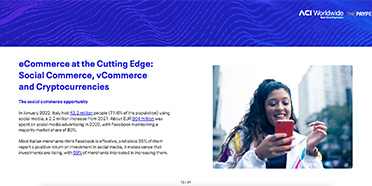
In January 2022, Italy had 43.2 million people (71.6% of the population) using social media, a 2.2 million increase from 2021. About EUR 904 million was spent on social media advertising in 2020, with Facebook maintaining a majority market share of 80%.
Most Italian merchants think Facebook is effective, and since 35% of them report a positive return on investment in social media, it makes sense that investments are rising, with 59% of merchants interested in increasing them.
12 / 19
The future of VR for shopping online
Virtual Reality (VR) is gradually gaining ground in Italy, and a study conducted by Capterra with 990 Italian consumers found out that 65% would like to use immersive VR for their shopping, while 35% are not interested in it. Out of those interested, 9% have had the opportunity to shop using VR technology, and 56% have not. Among those who would like to use VR in shopping, this is how much they would be willing to spend on VR equipment, according to the study: 21% up to EUR 50, 28% between EUR 51 and EUR 100, 19% between EUR 101 and EUR 300, 6% between EUR 301 and EUR 500, 2% between EUR 501 and EUR 1,000, and 1% over EUR 1,000.
In Italy, the preferred product categories for VR shopping are food and drinks, clothing and accessories, real estate, and furniture and decorating, whereas the most used devices are dedicated VR equipment (58%), VR app installed on smartphone and headset (31%), and browser to navigate in a 3D environment (11%).
Among the Italian shops that introduced v-commerce is Italian furniture store Natuzzi, which partnered with Microsoft to create mixed reality showrooms where clients use the HoloLens 2 headset to be immersed in a room and decorate it in an augmented reality setting. This allows clients to get a realistic feel prior to making a purchase – and since implementation, Natuzzi has reported a 35% increase in sales, accompanied by needing 50% less floor space in stores with augmented reality (AR).
65%
would like to use immersive
VR for their shopping,
while
35%
are not interested in it
13 / 19
Welcome to the metaverse
As for the metaverse, Gucci has made headlines with a sales experiment on Roblox in which they sold a virtual bag that was later resold at a higher price than the physical version of the bag is worth.
For 2022, during Milan Fashion Week Online, Benetton is launching a metaverse virtual experience, replicating their flagship store Corso Vittorio Emanuele. The visitors will witness a gaming experience that will allow them to accumulate QR codes in order to shop in the physical store. Italian fashion group OTB (brands include Diesel, Maison Margiela, Jil Sander) has created BVX (Brave Virtual Xperience), a company dedicated to operating in the metaverse, the first of its kind in the fashion industry.
14 / 19
The complexities of crypto
Capterra surveyed 1,003 Italians and found that 62% intend to use cryptocurrencies in the future. Of the 62%, 18% have used cryptocurrencies before, and 85% of them chose Bitcoin. The most purchased products and services using virtual currencies were payment services (33%), trading platforms (28%), clothing (23%), financial services (21%), and travel booking platforms (18%).
Italy’s 2019 Decree no. 135 defines aspects of cybercurrency operations and smart contracts – however, it does not provide a definition on cryptocurrency. Although often considered financial instruments, cryptocurrency tokens are categorised into four types under Italian law – investment tokens, security tokens, payment tokens, and utility tokens – and they are taxed like foreign exchange in Italy, with corporate income tax being about 29%, while personal income tax is 26%. On the personal level, capital gains tax applies to profits above EUR 51,645.69.

62%
of Italians intend to
use cryptocurrencies
in the future
15 / 19
Unpicking the Fraud Factor and Regulatory Environment
In Italy, merchants also tend to use more secure payment services, which helps to reduce fraud and blocks many unauthorized transactions. As a result, they are not as vulnerable to account take over or identify theft fraud as in other European countries.
However, as the base that uses the web has grown and the number of eCommerce transactions carried out by devices such as smartphones has also grown, it is essential for merchants to adopt a truly cutting-edge fraud prevention solution based on innovative and reliable parameters, especially as artificial intelligence and machine learning have evolved.
16 / 19
The fraudsters themselves have gained more expertise and this must be taken into account. Only by using cutting-edge fraud prevention solutions, merchants can really protect their customers. The new machine learning solutions that consider the attitude of potential fraudsters in real-time can guarantee a 10% improvement in performance over the first month of use. This is something that really makes a difference.
With the shift to online, it is even more pressing to have a strong card authentication process and secure payment methods to protect the customers from fraudulent activities such as identify theft or account take over.
Buying online and picking up in-store experienced nearly the same fraud attempts (+0.01%) as 2021, but transactions increased a lot, by 126% and the average ticket value also increased by 26%. Mobile also has seen similar fraud attempts, even though there was a 26% growth for both cross-border transactions.
In terms of sector trends, ticketing experienced a significant 5.5% increase in fraud rates and travel saw a nearly 4% increase in fraud attempts. This is in parallel to a significant rise in volumes as the sectors finally reopen, so fraudsters perhaps are trying to capitalize the opportunity.
17 / 19
In other sectors, we’ve seen a decrease in fraud activity, in part due to the focus on what is seen as more lucrative verticals like travel diverting attention. Retail fraud attempts decreased by 0.1% for domestic and cross-border transactions, while transactional volume saw an increase of 43% for cross-border and 6% for domestic eCommerce purchases – genuine transactions outpaced fraud significantly.
Telco experienced nearly 2% less fraud attempts for cross-border purchases and a 0.5% decrease for domestic purchases. Gaming had almost a 3% decrease in fraud attempts while digital downloads experienced a 0.5% decrease.
As the enforcement deadline for Strong Customer Authentication (SCA) has passed in Italy and most online payments now require two-factor authentication, it is relevant to have a look at how this impacts consumers and failure rates.
According to the SCA Economic Impact Assessment published by CMSPI in September 2021, the estimated failure rate in Italy grew between August 2020 and January 2021, when it reached a peak of 50%. Since then, the rate experienced a downward trend until July 2021, but it increased once more in August, reaching 37%. This translates into increased friction at the checkout for Italian consumers, so merchants selling in this market must ensure that they are taking all necessary measures to achieve optimal approval rates.

Estimated failure rate
peaked to
50%
between August 2020
and January 2021
18 / 19
Want to learn more about capitalizing on the growth of eCommerce in Italy?
Talk to ACI’s eCommerce consultants today, to discover winning payments and fraud management strategies for the new normal of eCommerce.
Sources
- Banca d’Italia - https://www.bancaditalia.it/pubblicazioni/index.html
- Centre for Retail Research - https://www.retailresearch.org/online-retail.html
- Casaleggio Associati - https://www.casaleggio.it/wp-content/uploads/2020/12/CA-E-commerce-2021-report-ENG__WEB-1.pdf
- Official website of the European Union - https://europa.eu/youreurope/citizens/consumers/shopping/guarantees-returns/index_en.htm
- J.P. Morgan’s Global E-Commerce Trends Report - https://www.jpmorgan.com/solutions/treasury-payments/global-ecommerce-trends-report
- Data reportal DIGITAL 2022: ITALY - https://datareportal.com/reports/digital-2022-italy
- Casaleggio Associati - E-commerce in Italy 2021 - https://www.casaleggio.it/en/download-focus-en/?downloadID=16197
- Capterra - 65% of Italians intend to use immersive virtual reality for their purchases - https://www.capterra.it/blog/1936/studio-realta-virtuale-immersiva
- Immersive Technology - Natuzzi Rolls Out an Exclusive Augmented Store for Virtual Furniture Shopping - https://immersive-technology.com/virtualreality/natuzzirolls-out-an-exclusive-augmented-store-for-virtual-furniture-shopping/
- Capterra - Cryptocurrencies in Italy: 62% of Italians intend to use them - https://www.capterra.it/blog/2294/criptovalute-italia-studio
- Freeman Law - Italy and Cryptocurrency - https://freemanlaw.com/cryptocurrency/italy-and-cryptocurrency/
- Global Legal Insights - Cryptocurrency Laws and Regulations 2022-Italy - https://www.globallegalinsights.com/practice-areas/blockchain-laws-and-regulations/italy#chaptercontent4
19 / 19